- Licensed CA Contractor·
- ADA Compliant Installs·
- Serving All of Southern California·
- Free Estimates·
- Licensed, Bonded & Insured
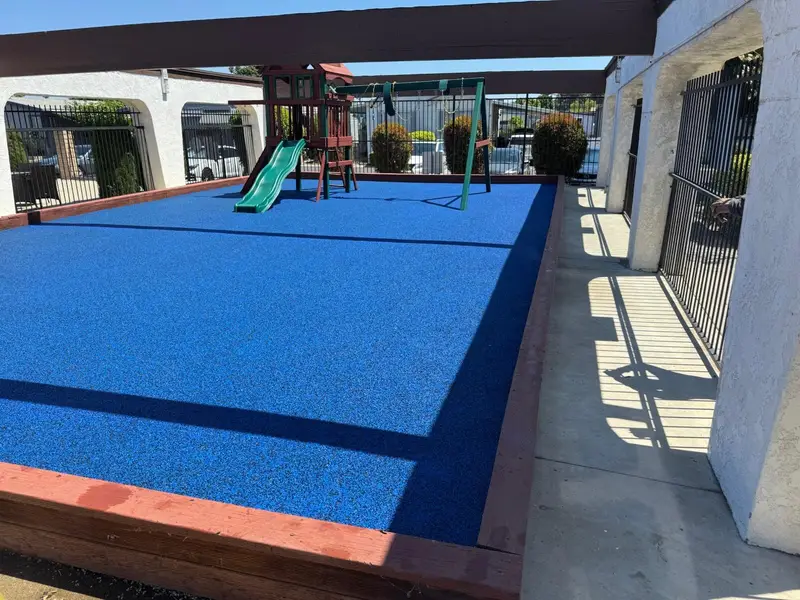
Poured in Place Rubber Playground Surfacing
From your equipment list to a finished surface: how thickness, layout and base are worked out.
Quick answer
Turbo Surfacing installs poured in place rubber playground surfaces for schools, parks, churches and HOAs. We work from your equipment list, specify thickness from critical fall height following ASTM F1292 and plan use zones, drainage and access. We are licensed, bonded and insured and respond within 24 hours.
Key takeaways
- Start with an equipment list and the tallest platform heights.
- Thickness is specified from critical fall height, following ASTM F1292.
- The surface must cover each use zone, not just the equipment footprint.
- Base, drainage and edges decide how long the surface lasts.
- Accessible routes matter as much as the surface itself.
A playground surface starts with a list: what equipment is there, how tall each piece is and where it sits. Everything else follows from that. The thickness of the rubber, the shape of the surface, the drainage and the access routes are all worked out from the equipment and the site.
This page walks through that process in the order we do it. If you are a school, a church, an HOA or a parks department planning a new surface, it shows what to gather, what we ask and what you receive.
Start with the equipment list
Gather the make and model of each structure, or at least its type and overall height. Note the tallest platform or deck on each, because that is what sets the fall height. Include swings, slides, climbers, spring riders and any equipment that is planned for the future. If you have the manufacturer's documentation, send it. If you do not, photographs and a tape measure are enough to start.
Equipment manufacturers rate each structure for a critical fall height, and the surface under and around it has to be suitable for that height. If equipment is old and no documentation remains, we measure on site and note what we found.
Fall height sets the thickness
Critical fall height is the height at which a surface still limits the forces on a falling child to accepted limits. ASTM F1292 is the standard test method for impact attenuation of playground surfacing. Thickness of the cushion layer is specified from the critical fall height of the equipment above it, so taller equipment needs a thicker surface.
A surface does not need to be the same thickness everywhere. Under a tall climber it may be thick, and along a path or under a low spring rider it may be thinner. We lay out thickness zones and show them in the written scope.
Use zones and layout
The surface has to cover the use zone around each structure, not just its footprint. Use zones depend on the type of equipment, and swings and slides need larger areas than stationary pieces. Where zones overlap, they have to be coordinated so no area is left uncovered or under thickness.
We measure each zone, mark where they overlap and add paths, entries, benches and any other features. If you are redesigning the playground, bring the plan and we will help translate it into a surface layout.
Base, drainage and edges
The base is graded and compacted with drainage built in, so water does not sit under the cushion layer. Old surfacing, such as wood fiber, sand or worn rubber, is removed, and soft or wet areas are corrected. Existing concrete or asphalt is inspected for cracks and drainage.
Edges contain the surface and keep it from lifting. Curbs, plastic edging or existing borders all work, and each affects drainage and transitions. Tell us about slopes, tree roots and any history of flooding, because they change the base design.
Color, patterns and graphics
Color and pattern make a playground memorable. We can combine several colors, borders, shapes and graphics such as mazes, hopscotch grids, letters and logos. Darker colors absorb more heat in direct sun, and lighter colors show dirt, so we discuss trade offs for your site. Keep designs simple near exits from slides and swings, where wear is heaviest.
We provide color samples and a layout drawing, and the written scope lists colors, patterns and any custom graphics.
Accessible routes
A playground that cannot be reached is not much use. A firm, stable route from parking or a sidewalk to the play area, and a surface firm enough to cross once there, matter for children and caregivers who use wheelchairs, walkers or strollers. Poured rubber is generally a good fit because it is seamless and level, but entries, ramps and thresholds matter just as much.
Tell us where accessible routes are or should be. We review slopes and edge heights and note recommendations in the scope. Many agencies have accessibility requirements in bid documents, and we are glad to review them early.
Rules that may apply
Licensed child care centers must cushion the area under and around climbing equipment, swings and slides under Title 22, section 101238.2. Publicly funded projects generally follow California prevailing wage rules, with contractor registration and payroll reporting. Associations should keep play surfaces on the reserve schedule.
Send your bid documents or requirements with your request. We will tell you what documentation we can provide and flag anything that may affect the schedule.
Inspection and upkeep
Inspect the surface regularly. Look at edges, transitions and wear points such as swing and slide exits for lifting, granule loss or hardening, and record what you find. A qualified playground safety inspector can review equipment and surfacing as part of a safety program. Sweep, rinse with clean water and avoid solvents.
Warranty terms vary by product and system and are provided in writing with each estimate. We explain what care keeps coverage in place. See our maintenance guide for a checklist.
Next steps
Send photos and rough dimensions through the free estimate form and we respond within 24 hours. Site walks are available the next day or later, depending on availability, and you receive a written scope after the visit. Send your equipment list and the tallest platform heights with your request. See also the rubber cost guide and installation process.
What to know before you start
Name the person responsible for temporarily moving equipment that conflicts with the playground surfacing footprint. Include where that equipment will wait so it is not set down on rubber that remains closed for curing.
Frequently Asked Questions
Sources
- 22 CCR section 101238.2, Outdoor Activity Space
- California Department of Industrial Relations, public works enforcement
- U.S. Access Board, ADA accessibility standards
Last reviewed:
By Turbo Surfacing Solutions team · Planning updated:
KEEP EXPLORING.
Other Southern California surfacing projects we specialize in — handpicked because they share the same materials, standards, or installation crew as this page.
Related Poured-In-Place Rubber & Resources
Sibling services, cities where we install this, and blog posts that go deeper.
More Poured-In-Place Rubber
- PIP Rubber InstallationProfessional Installation
- PIP Installation ProcessOur Process
- PIP Rubber MaintenanceMaintenance Guide
Cities We Serve
- Poured-In-Place Rubber in Chula Vista
- Poured-In-Place Rubber in San Diego
- Poured-In-Place Rubber in Oceanside
Get a Quote for Playground Surfacing Contractor San Diego
Get a free, no-obligation estimate for your project. Our team responds within 24 hours.
Get Playground Quote