- Licensed CA Contractor·
- ADA Compliant Installs·
- Serving All of Southern California·
- Free Estimates·
- Licensed, Bonded & Insured
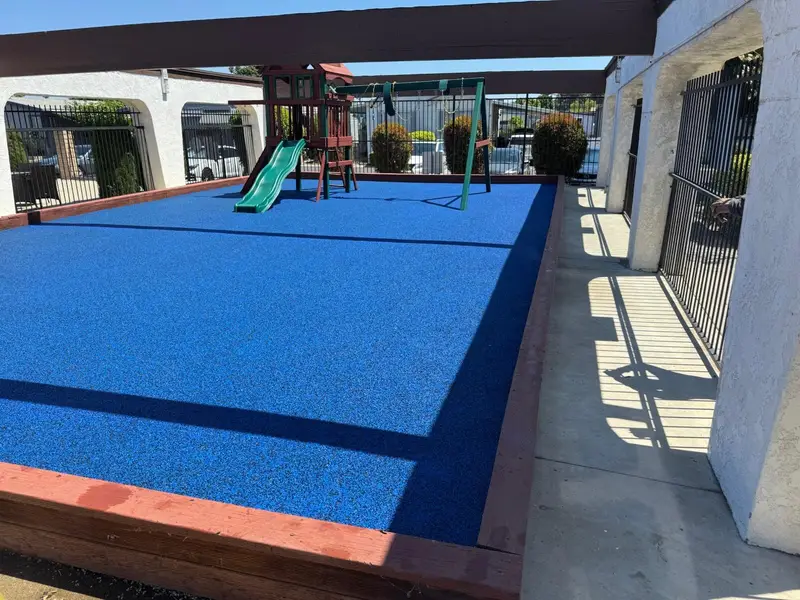
School Safety Surfacing: Comparing Options for Campus Playgrounds
How schools compare wood fiber, rubber tiles and poured in place rubber for a safer, lower maintenance playground.
Quick answer
Turbo Surfacing installs poured in place rubber for school playgrounds and compares it honestly with wood fiber and tiles. Surface choice affects safety, access and upkeep over many years. We are licensed, bonded and insured and respond to estimate requests within 24 hours.
Key takeaways
- Compare surfaces by cost of ownership, not only first price.
- Wood fiber and sand need regular topping up and are hard for wheelchairs.
- Poured rubber is seamless and designed to the equipment's fall height.
- A simple, regular inspection routine keeps a safety program working.
- Districts usually need license and insurance documents with a bid.
A school playground is a safety system as much as a place to play. Equipment, supervision, rules and the surface all work together. The surface is the part that does its job at the moment someone falls, and it is also the part that needs the most attention over the years.
This page is for administrators, risk managers and facilities directors comparing surfacing options. It explains how common surfaces differ, what each costs over time, how accessibility and upkeep fit into the decision and how to set up an inspection routine.
Comparing common school playground surfaces
Engineered wood fiber is the lowest cost option up front. It compacts, scatters and breaks down, so it needs regular raking and topping up, and it is hard for wheelchairs to cross. Sand and pea gravel have similar maintenance needs and can attract animals and hide debris. Rubber tiles install quickly and can be replaced in sections, but joints can shift and collect debris, and the base underneath matters a great deal. Poured in place rubber is seamless, can be designed to the equipment's fall height and needs sweeping and periodic inspection rather than topping up.
Each has a place. The right choice depends on budget, staffing for upkeep, accessibility needs and the rules that apply to your campus. We lay out the tradeoffs for your site and tell you honestly when a lower cost surface may be enough.
Cost of ownership, not just first price
A surface that costs less today can cost more over ten years once labor, materials and closures are counted. Wood fiber needs regular topping up and raking to keep depth, and that is labor and material every year. Tiles may need replacement of damaged sections. Poured rubber costs more up front and generally less to keep in service.
Ask each contractor for the same information, then add the cost of upkeep over several years to each. Our cost guide explains the factors, and we can help you set up a comparison your board or district can follow.
Matching the surface to the equipment
Whatever surface you choose, it has to suit the equipment above it. Each structure has a critical fall height, and thickness is specified from it, following ASTM F1292 for impact attenuation. Wood fiber and tiles also need to be installed to a depth or thickness that suits the height, and wood fiber compacts, so depth drops over time.
Tell us the type and the tallest platform height of every structure. If you plan to add taller equipment, say so, because the surface under it may need to change.
Access for every child
Campuses serve children with a range of abilities, and the playground should too. A firm, stable surface lets children who use wheelchairs and walkers reach and use the play area, and loose fill surfaces are hard for them to cross. A route from the classroom or parking area to the surface, with level entries, matters as much as the surface itself.
District accessibility requirements may appear in your bid documents, and we are glad to review them early. We note our recommendations in the written scope.
Building an inspection routine
A safety program is a routine. Assign someone to walk the playground on a regular schedule and record what they find. Look at surface depth or condition, edges and transitions, equipment and anything that has changed since the last walk. A qualified playground safety inspector can review equipment and surfacing as part of a broader program.
For rubber, look for lifting edges, granule loss and hardened spots. For wood fiber, check depth under swings and slide exits. Keep a log, and keep it simple enough that staff actually use it.
Shade, heat and drainage
Playground surfaces in full sun can get hot, and many campuses are adding shade structures. Lighter colors help, and shade helps more. Drainage matters, since a surface that stays wet is slippery and unpleasant. We look at where water goes and raise problems early.
Placement of shade structures, trees and benches should be coordinated with the surface layout, so footings and edges are planned together.
Funding and phasing options
Many schools fund playground work through a mix of district budgets, bond measures, grants and parent group fundraising. Each has its own timeline and paperwork, so it helps to plan the surface alongside the funding calendar. Some groups fund the equipment and the surface in separate years, which means the surface needs to match equipment that may be replaced later.
Phasing can also help. A school can surface the highest risk or most used area first, then continue in later years, if seams, edges and thicknesses are planned from the start. We lay out phases so each one is usable on its own, and we note where later phases will connect.
Bids and paperwork
Publicly funded school work generally follows California prevailing wage rules, with contractor registration and payroll reporting. Districts often ask for license and insurance documents with the bid. We are licensed, bonded and insured, and we tell you early what documentation we can provide. Send the bid package with your request, and we will flag anything that may affect the schedule.
Next steps
Send photos and rough dimensions through the free estimate form and we respond within 24 hours. Site walks are available the next day or later, depending on availability, and you receive a written scope after the visit. For scheduling, phasing and facilities management guidance, see our page on schools and daycare.
What to know before you start
Include custodial cart routes on the school closure drawing. Staff servicing neighboring buildings should not have to infer which freshly surfaced crossing remains unavailable.
Frequently Asked Questions
Sources
- 22 CCR section 101238.2, Outdoor Activity Space
- California Department of Industrial Relations, public works enforcement
- U.S. Access Board, ADA accessibility standards
Last reviewed:
By Turbo Surfacing Solutions team · Planning updated:
KEEP EXPLORING.
Other Southern California surfacing projects we specialize in — handpicked because they share the same materials, standards, or installation crew as this page.
Related Poured-In-Place Rubber & Resources
Sibling services, cities where we install this, and blog posts that go deeper.
More Poured-In-Place Rubber
- PIP Rubber InstallationProfessional Installation
- PIP Installation ProcessOur Process
- PIP Rubber MaintenanceMaintenance Guide
Cities We Serve
- Poured-In-Place Rubber in Chula Vista
- Poured-In-Place Rubber in San Diego
- Poured-In-Place Rubber in Oceanside
Get a Quote for School Safety Surfacing
Get a free, no-obligation estimate for your project. Our team responds within 24 hours.
Request School Quote