- Licensed CA Contractor·
- ADA Compliant Installs·
- Serving All of Southern California·
- Free Estimates·
- Licensed, Bonded & Insured
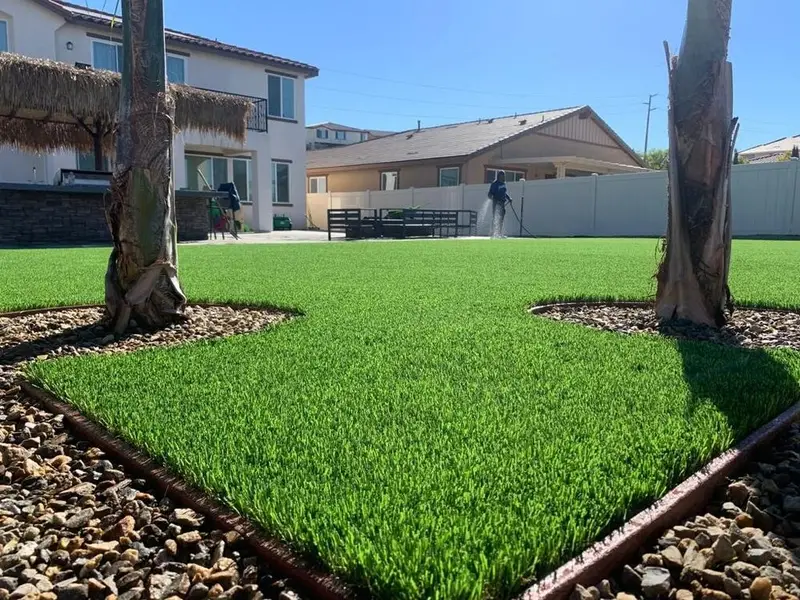
Artificial Grass Croquet Courts for Homes, Clubs and Estates
A smooth, true playing surface that looks like a manicured lawn all year without mowing, rolling or watering.
Quick answer
An artificial grass croquet court uses short, dense turf over a flat compacted base so balls roll true and hoops stay stable. It avoids mowing, rolling and seasonal bare spots, and it drains quickly after rain. Turbo Surfacing is licensed, bonded and insured, and builds home, club and event courts with careful grading and hoop planning.
Key takeaways
- A flat compacted base gives true roll.
- Short dense turf suits croquet.
- Sleeves keep hoops stable.
- Brushing keeps the surface even.
Croquet depends on a surface that is flat, fast and consistent. Natural lawns can deliver that, but only with constant mowing, rolling and watering.
This page explains how an artificial grass croquet court is built, what size to plan for and how to look after the surface.
Court size and layout
A full size court is a generous rectangle, and many backyards cannot fit one. Reduced courts keep the same hoop pattern at smaller scale, which still plays well for casual games. We measure your yard, mark the layout with stakes and string and show you how the hoops, center peg and boundaries will sit.
Side space for seating and shade matters too, so we plan a border around the playing area.
Turf choice and ball roll
Croquet needs short pile, dense stitching and a firm cushion under foot. Longer fibers slow the ball and steer it off line. We choose a low, tight turf with fine sand infill to control speed and keep the surface stable.
Samples are tested with real croquet balls, so you can see how they roll before approving the order.
Base and grading
The base decides how true the court plays. We excavate, spread crushed rock in layers and compact each one, then fine grade with a laser or long screed. Slope is kept gentle, just enough to shed water, and any crown is subtle.
A court with dips or ridges will send balls astray and cannot be fixed with brushing. We take the time to get this right.
Hoops, pegs and sleeves
Hoops and pegs need firm footing. Sleeves are set into the base before the turf goes down, so hoops can be placed and removed cleanly without tearing fibers. Turf is cut around each sleeve with a neat edge, and covers keep the holes tidy when the court is not in use.
Having hoops in the right place for repeated play is half the satisfaction of a home court.
Seams, edges and borders
Full width rolls reduce seams, and any joins are placed away from the main playing lanes. Seams are glued and weighted so they stay flat. Borders can be wood, stone, concrete or metal, depending on your style.
A firm border keeps the turf from lifting and gives the court a finished frame.
Drainage and weather
Water should pass through the turf and base and away from the court. Perforated backing and open rock help, and we add drains where soil is dense. After a storm, a well built court is playable far sooner than a natural lawn.
Planning for runoff from nearby slopes and roofs prevents puddles at the edges.
Estates, weddings and events
Croquet lawns are popular for weddings, garden parties and corporate events. An artificial surface stays presentable on short notice and handles guests in dress shoes and heels. Clean white lines, matching hoops and a tidy border give the setting a classic look.
We coordinate with event planners on layout, power, lighting and rental equipment.
Clubs and community courts
Clubs need courts that survive league play and tournaments. Turf holds up to heavy use when brushed and maintained, and replacing worn sections is easy. We plan multiple courts with shared borders, walkways, seating and shade.
Clear drawings help boards and members visualize the facility before work begins.
Care and brushing
Brush the surface regularly so fibers stay upright and infill remains even. Remove leaves and debris, and rinse dust away. Check hoop sleeves, borders and seams every season. Keep pets and sharp objects off the court.
A short routine keeps the court in match condition.
Compared with natural grass courts
Natural grass can be wonderful when it is maintained by someone who knows what they are doing. That means regular mowing, rolling, watering and renovation. Artificial turf is slower in some ways, but it is consistent, always green and available in any weather.
Many owners prefer the predictability and the time they get back.
Other lawn games
A flat turf court also works for lawn bowling, bocce, badminton and general play. Children enjoy running on it, and adults enjoy the clean surface. Mark the croquet lines with removable tape or paint for games, and fold them away for other uses.
Planning for multiple uses lets the space serve the whole household.
Lighting and evening play
Evening croquet is popular in warm weather. Low glare lights, path lights and string lights make the court usable after dark. We run conduit before the turf goes down and place fixtures so shadows do not confuse play.
Power for speakers or drink stations is easy to include.
Landscaping around the court
Hedges, flower beds, benches and shade trees frame a croquet lawn. We help you choose planting that stays out of the way of play and does not drop heavy debris on the court. Pergolas or pavilions offer shade and storage for equipment.
A well designed setting makes the court feel part of the garden.
Project steps and timing
Typical steps are layout, excavation, base placement, sleeve installation, turf placement, seam joining, infill and brushing. A backyard court usually takes about a week, depending on size and borders. Clubs take longer.
We provide a written schedule and walk the court with you, rolling a ball to test it.
Testing ball roll and speed
Speed is the first thing serious players ask about. Pile height, stitch density, infill depth and the cushion beneath all change how far a ball travels from a given stroke. We lay out two or three sample panels on a flat board and roll your own balls across them, in both directions, so you can see whether the grain pulls a shot off line.
Once a sample is chosen, we record the pile height and infill depth so future repairs match.
Slopes, roots and soil conditions
Many yards have a slope, a mature tree or clay that holds water. Slopes can be graded flat with a cut and fill, or terraced with a retaining edge. Roots near the surface are removed where practical, because they heave the base over time and leave a lump in the middle of a lane.
Expansive clay needs deeper rock and good drains, so the court stays level through wet and dry seasons.
Storing equipment and protecting the court
Mallets, balls, hoops and pegs need a dry home close to the lawn. A small cabinet or bench with a lid keeps equipment tidy and shaded. Covers over sleeve holes stop dirt and leaves from filling them, and a simple rule against sharp heels and spikes protects the surface between matches.
Getting an estimate
Our artificial grass cost guide explains what moves the price. Send photos and rough dimensions through the free estimate form and we respond within 24 hours. Site walks are available the next day or later, depending on availability, and you receive a written scope after the visit.
What to know before you start
Review the hoop-fixing method with the turf system supplier before installation. Removable play equipment needs a planned connection detail instead of new punctures made after the court is finished.
Frequently Asked Questions
Sources
Last reviewed:
By Turbo Surfacing Solutions team · Planning updated:
KEEP EXPLORING.
Other Southern California surfacing projects we specialize in — handpicked because they share the same materials, standards, or installation crew as this page.
Related Artificial Grass & Resources
Sibling services, cities where we install this, and blog posts that go deeper.
More Artificial Grass
- Artificial Grass InstallationProfessional Installation
- Turf Installation ProcessOur Process
- Artificial Grass MaintenanceMaintenance Guide
Get a Quote for Artificial Grass Croquet Courts
Get a free, no-obligation estimate for your project. Our team responds within 24 hours.
Request Court Quote