- Licensed CA Contractor·
- ADA Compliant Installs·
- Serving All of Southern California·
- Free Estimates·
- Licensed, Bonded & Insured
Polyaspartic and Polyurea Floor Coatings
UV stable, flexible and fast curing coatings, and how they compare with epoxy on garages, patios and commercial floors.
Quick answer
Turbo Surfacing installs polyaspartic and polyurea floor coatings, often as topcoats over epoxy and sometimes as full systems. They resist sunlight, flex with the slab and cure quickly, but they also demand skilled application. We are licensed, bonded and insured and respond to estimate requests within 24 hours.
Key takeaways
- Polyaspartic topcoats resist sunlight and keep color and gloss.
- These coatings cure quickly but give the crew little working time.
- They are often used over an epoxy base.
- Preparation and moisture testing still come first.
- Installer skill matters more than with slower coatings.
Epoxy bonds well and resists chemicals, but it can yellow in sunlight and takes time to cure. Polyaspartic and polyurea coatings were developed to address both. They are stable in sunlight, flexible, tolerant of a wider range of temperatures and quick to cure. They also have their own tradeoffs, and they are less forgiving to install.
This page explains what these coatings are, how they compare with epoxy, where they fit and what to ask when a bid includes them.
What they are
Polyurea is a family of fast reacting coatings. Polyaspartic is a type of aliphatic polyurea designed to resist ultraviolet light and to give a long working life. Both are used as topcoats over epoxy and, in some products, as complete floor systems. They produce a hard, clear, durable surface that holds color and gloss.
Different manufacturers offer different formulations, and properties vary. We name the product in the scope and explain what it is designed to do.
Sunlight and color stability
Aliphatic polyaspartic topcoats resist the amber shift that epoxy shows in sunlight. That matters on garages with open doors, patios, entries and any floor in a room with large windows. A floor with a polyaspartic topcoat tends to keep its color and gloss longer in light.
For sun exposed floors, the topcoat decision is usually the most important one.
Cure speed and scheduling
These coatings cure faster than most epoxies. That can shorten the time a garage or a store is out of use, but fast cure also means a short working time, and the crew has to apply the material quickly and skillfully. Cure time still depends on temperature and humidity, and we tell you when foot traffic and vehicles can return.
If your schedule is tight, tell us at the estimate stage. We choose products and plan crew size to fit the window, and we do not promise speeds the conditions cannot deliver.
Flexibility and temperature tolerance
Polyurea and polyaspartic coatings are generally more flexible than rigid epoxy, which helps them tolerate slab movement and thermal expansion. They can also be applied across a wider range of temperatures, which helps in cool or hot weather. Flexibility does not make a coating immune to cracks that move, and joints still need treatment.
We assess the slab and the joints and tell you what to expect.
As a topcoat and as a full system
The most common use is a polyaspartic topcoat over an epoxy base, which combines the bond and body of epoxy with the UV stability and abrasion resistance of polyaspartic. Some products are used as full systems, with a polyaspartic basecoat and flake and a polyaspartic topcoat. These are thinner and faster, and they suit certain residential and light commercial floors.
We recommend the system that suits the slab, the use and the schedule, and we explain why.
Where these coatings fit
Garages, patios, pool decks, entries, showrooms with large windows, retail and light commercial floors. They are less suited to floors with severe chemical exposure that a thick epoxy or urethane cement system handles better, and to slabs with active moisture problems that have not been addressed.
Exterior and semi exposed areas
Patios, walkways, pool decks and open garages see sun and weather. A polyaspartic system with an anti slip additive can be a good choice, because it resists sunlight and tolerates temperature changes. Moisture remains a concern on any slab on grade, and standing water, irrigation and drainage need attention.
Tell us about slope, drainage and how the area is used, and we will tell you plainly whether a coating is a good solution or whether another surface would last longer.
Garage floors in detail
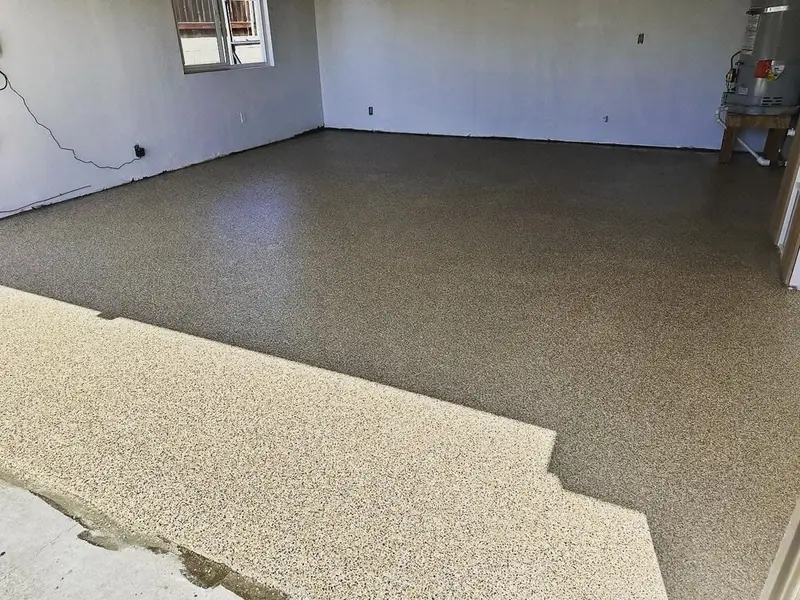
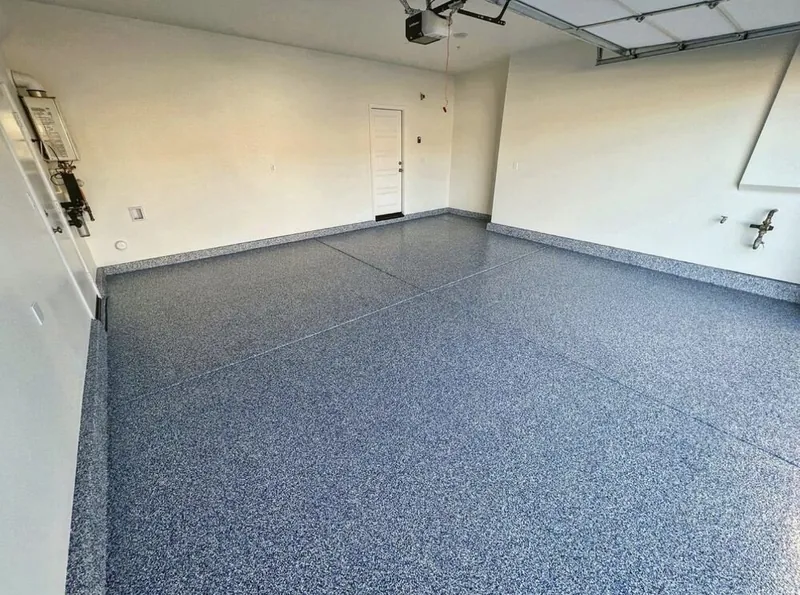
Garages are the most common home for a polyaspartic topcoat. It resists hot tire marks, stays clear and glossy in sun and cleans easily. A decorative flake base under a polyaspartic topcoat is a popular system, and a full polyaspartic system with flake is a thinner, faster option.
Both need a prepared slab. Ask which is proposed, what the thickness is and how cracks and joints will be handled.
Questions to ask about a polyaspartic bid
Ask whether the coating is a topcoat over epoxy or a full system, and why. Ask for the product name and the number of coats. Ask how the slab will be prepared and tested for moisture. Ask how many people will be on site and how long the working window is. Ask how cracks and joints will be treated and what the warranty terms are. Put the answers in writing and compare them across bids.
Preparation still comes first
A fast curing topcoat does not change the need for a ground, clean, dry, sound slab. Preparation and moisture testing are the same as for epoxy, and cracks and joints are treated in the same way. A bid that treats a polyaspartic coating as a shortcut around preparation should be questioned.
Why installer skill matters
Short working time and high reactivity leave little room for error. Roller marks, missed spots and lap lines are hard to correct. Experience matters, and so does crew size and planning. Ask any contractor how many people will be on site, how they will divide the work and how they handle small corrections.
Care and expectations
Sweep or dust mop and clean with a mild cleaner. Wipe up spills promptly and avoid harsh solvents. Use mats at entries and pads under equipment. The surface is hard, but it can be scratched. Warranty terms vary by product and system and are provided in writing with each estimate, and we explain what care keeps coverage in place. Keep a record of the product name, the installation date and the care instructions we give you. If a repair is ever needed, matching the original product is easier when the details are on file, and warranty questions are answered faster.
Temperature, humidity and timing
Weather affects these coatings differently from epoxy. Heat shortens the working time, and cool, damp conditions slow the cure. A crew that understands this schedules work for the right hours and prepares enough hands. Tell us when the area is shaded or sunny and what the season is, and we will plan timing and materials to match.
Cost and next steps
Our epoxy floor cost guide explains what moves the price. Send photos and rough dimensions through the free estimate form and we respond within 24 hours. Site walks are available the next day or later, depending on availability, and you receive a written scope after the visit. See also our page on epoxy flooring systems.
What to know before you start
Ask for a written sequence of coat application and access-release decisions. A product described as fast curing still needs a clear record of which activities are allowed at each handover stage.
Frequently Asked Questions
Sources
Last reviewed:
By Turbo Surfacing Solutions team · Planning updated:
KEEP EXPLORING.
Other Southern California surfacing projects we specialize in — handpicked because they share the same materials, standards, or installation crew as this page.
Related Epoxy & Concrete Polishing & Resources
Sibling services, cities where we install this, and blog posts that go deeper.
Get a Quote for Polyurea & Polyaspartic Coatings
Get a free, no-obligation estimate for your project. Our team responds within 24 hours.
Get Polyaspartic Quote