How to Budget Playground Surfacing in a California HOA Reserve Study
California HOAs must plan for components that wear out. Here is how to estimate useful life and cost for a play surface, with example math and an annual walk checklist.
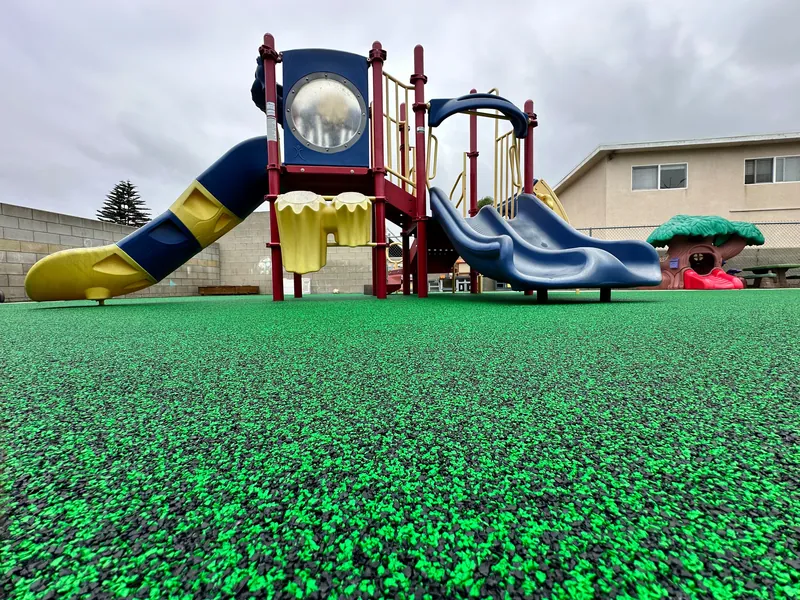
Quick answer
Yes, if your association maintains the play area. California Civil Code 5550 requires a reserve study every three years, with annual review, listing components with under 30 years of life, their remaining life, replacement cost and a funding plan. Estimate cost per square foot, add inflation, and fund the surface over its useful life.
Key takeaways
- Civil Code 5550 requires a reserve study at least every three years, reviewed annually, covering components with under 30 years of remaining life.
- Published planning lives for poured rubber run from roughly 8 to 15 years, depending on binder, sun exposure, use and maintenance.
- Every site prices differently, so get at least three written bids with the same scope before you set the reserve number.
- Example math with made up numbers: a 2,000 square foot area at an example $15 per square foot, with 3 percent yearly cost growth, is about $40,300 in 10 years, or roughly $4,030 per year.
- An annual board walk with dated photos gives your reserve specialist better numbers.
Last reviewed October 5, 2026. This is general information for California HOAs, not legal or financial advice. Your reserve specialist's numbers and your association's attorney govern your decisions.
Does playground surfacing belong in an HOA reserve study?
In most cases, yes, when the association owns and maintains the play area. California Civil Code section 5550 requires a reserve study that identifies the major components the association must repair, replace, restore or maintain and that have less than 30 years of remaining useful life. A poured rubber or turf play surface wears out on a predictable schedule, so it fits that description.
Here is how the statute's required contents map to a play surface:
What the reserve study must include | What it means for playground surfacing |
|---|---|
Major components with under 30 years of remaining life | The surface, and in many cases the base and edging |
Probable remaining useful life | How many years until the surface needs replacement, based on age, condition and sun exposure |
Estimate of repair or replacement cost | Square feet times a current installed price, plus removal and base work |
Reserve funding plan | The yearly contribution that builds the money by the replacement date |
The law calls for a visual inspection of accessible areas and a reserve study at least once every three years, with the board reviewing the study annually and adjusting reserve requirements as needed. Associations whose major components are worth less than half of the gross budget, excluding reserves, may fall outside the requirement.
How long does a poured rubber play surface last?
Published estimates vary, which is exactly why your reserve specialist needs to see the surface in person. Planning figures you will see run from roughly 8 to 15 years. One industry reference puts well installed poured in place rubber at about 10 years with an aromatic binder and up to 15 years with a premium aliphatic binder, and notes that shade, good maintenance and periodic cap coats can extend that.
Four conditions move the number:
- Sun exposure. UV fades color and ages binder, and San Diego County has plenty of both.
- Binder type. Aliphatic binders are generally rated to last longer than aromatic ones.
- Use level. A busy community playground wears faster than a small tot lot.
- Maintenance. Rinsing gently, removing debris, and fixing small damage early all extend life.
For comparison, loose fill surfaces such as wood fiber compact over time and need topping off every two to three years, so they trade a lower upfront cost for a recurring operating expense.
How much should you budget to replace it?
Every site is different. Area, the surface thickness needed for your tallest equipment, base condition, access, drainage and color or pattern all change the number. The only reliable figure is a written bid with a scope your board can compare, so ask for at least three bids with the same scope. Our cost guides can help with early planning.
Here is an example of how a bid turns into a yearly reserve contribution. These are made up round numbers to show the method. They are not Turbo Surfacing pricing and not a quote:
Example assumption | Value |
|---|---|
Play area | 2,000 square feet |
Example bid price | $15 per square foot |
Cost today | $30,000 |
Useful life | 10 years |
Cost escalation | 3 percent per year |
Cost in 10 years | about $40,300 |
Straight line yearly contribution | about $4,030 |
For a 100 home community | about $40 per home per year, or about $3.36 per month |
Reserve specialists use more refined methods that include interest and the status of other components, but the logic is the same: current cost, adjusted for inflation, spread over the remaining life.
When should the board repair instead of replace?
What you see | Typical response |
|---|---|
A few cracks or a lifting edge | Targeted patch repair, then recheck at the next walk |
Thin or worn spots at slide exits and swing zones | Local repair or resurfacing, based on an installer's assessment |
Widespread fading, crumbling or loose granules | Evaluation for recoating or replacement |
Loss of cushioning or failed impact testing | Plan replacement |
This table is a typical pattern, not a rule. A qualified installer or playground safety inspector should assess your surface before the board commits.
What should the board check on the annual walk?
- Walk the full surface and mark cracks, open seams and lifting edges
- Look closely at slide exits, swing zones and entry paths where wear concentrates
- Check drainage and look for ponding after rain or irrigation
- Look for trip hazards where the surface meets concrete or turf
- Note fading, chalking or loose granules
- Photograph and date every issue
- Ask the installer for the current critical height documentation for the installed system
- Send findings to the reserve specialist for the annual review
Do HOA play areas have to meet ADA and ASTM standards?
It depends on how the play area is used and who it serves, so ask the association's attorney. Many boards follow the same standards regardless, because they reflect accepted safety practice. ASTM F1292 measures the fall height a surface can absorb, ASTM F1951 addresses wheelchair accessibility of the surface, and the 2010 ADA Standards for play areas reference both and call for regular inspection and maintenance. If a surface is covered, keeping records of inspections and repairs is the best protection.
What should a replacement bid include?
- Removal and disposal of the old surface
- Base preparation and drainage
- Surface thickness sized to the fall height of the tallest equipment
- Manufacturer test data for the installed system
- ASTM F1951 data for accessible routes
- Colors, patterns and edge details
- Warranty terms and who services it
- Contractor license number and proof of insurance
- A schedule that limits how long the play area is closed
Get at least three written bids with the same scope so the board can compare real differences instead of different assumptions.
Where can you check the sources?
- California Civil Code section 5550, reserve study requirements
- Davis Stirling guide to reserve studies
- Poured in place surfacing overview and lifespan notes
- Access Board guide to accessible play surfaces
- ASTM F1292 standard summary
What is the next step?
If your reserve study is coming up, give your specialist current numbers. Use our cost guides for a rough budget by square foot, run your numbers in the ROI calculator, read about poured in place rubber, or request a free estimate and we will measure the area and write up the scope for your board.
Related guides & services
Frequently asked questions
Is playground surfacing a reserve component for a California HOA?
In most cases, yes, when the association owns and maintains the play area. Civil Code section 5550 requires the reserve study to list major components the association must repair or replace that have under 30 years of remaining life, with their useful life, replacement cost and a funding plan. Your reserve specialist decides how to classify each item.
How often does a California HOA need a reserve study?
At least once every three years the board must have a visual inspection of accessible major components as part of a reserve study, and the board must review the study annually. Associations whose major components are worth less than half of the gross budget, excluding reserves, may fall outside the requirement under section 5550.
How long does poured rubber last in San Diego?
Published estimates range from roughly 8 to 15 years. One industry reference cites about 10 years with an aromatic binder and up to 15 years with a premium aliphatic binder. Sun exposure, use level and maintenance move the number, so have your reserve specialist inspect the actual surface.
What does it cost to replace an HOA playground surface?
It depends on the area, the thickness needed for your tallest equipment, the condition of the base, access, drainage and the colors or patterns you choose. Get at least three written bids with the same scope, then use the example math in this article to see how a bid turns into a yearly reserve contribution.
Ready for a quote on your project?
Free on-site consultation, no pressure. Licensed California surfacing contractor.
Get Free Estimate